
San Marcos Elite Concrete handles commercial concrete in San Marcos, TX and across surrounding cities including Redwood, Kyle, Geronimo, Buda and Lockhart, with more than twenty years of work on lots, approaches, pads and pedestrian routes. Commercial concrete differs from residential in two ways that matter more than scale: it is held to accessibility standards, and the building usually has to keep trading while the work happens.
Both of those are scheduling problems as much as construction ones. An accessible route has to remain available every day, not be restored at the end. Entrances, fire lanes and delivery access have to keep working. We plan the phasing and the temporary routes before the first saw cut, because a phase plan agreed afterward is a phase plan that closes your doors.
The other difference is who reviews the work. Approaches, sidewalks and ramps in the right of way are reviewed by the city against published standards rather than approved on site, and some projects have to be registered before construction. We identify what your project triggers at bid time and say who is responsible for filing.
Parking Lots and Paved Areas
Panel Repair, Replacement and Phased Scopes
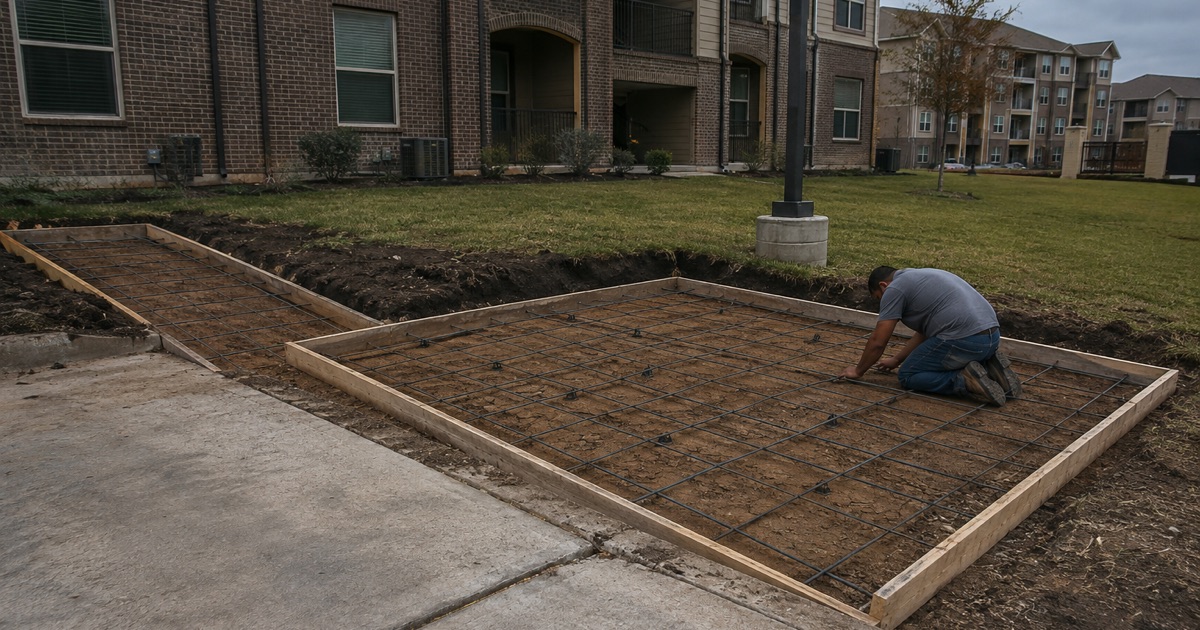
A failing concrete lot is rarely uniformly failing, so we survey it panel by panel and sort panels into repair, replace and leave alone. That produces a phased scope you can budget across seasons rather than one number for the whole surface, and it lets us sequence work so your parking count and fire lane stay usable throughout.
Dumpster Pads, Container Pads and Loading Areas
Waste enclosure pads take point loads from steel wheels and repeated impact from a front-load truck, which is why a lot-standard slab does not survive under one. Thickness, reinforcing and an approach apron sized to the truck’s turning radius are the whole job. Where a city publishes the specification we build to it exactly, and where it does not we build to the actual loading.
Curb, Gutter, Islands and Wheel Stops
Curb and gutter controls where water goes and where vehicles do not, and valley gutters carry drainage across drive lanes without a grate to maintain. Islands, bollards and wheel stops protect the things that get hit. We set these out against the striping and circulation plan rather than pouring them and letting the striper work around them afterward.
Accessibility and Code Work
Curb Ramps and Detectable Warnings
Curb ramps are where accessibility work is most often rejected, because slope, landing, flares and the detectable warning surface all have to be correct at once. PROWAG holds curb ramp running slope to 1:12, about 8.3 percent, and cross slope to 1:48, about 2.1 percent, and TxDOT Item 531 limits flares to no more than 10 percent. Truncated domes carry specified size, spacing and contrast.
Accessible Routes, Parking and Access Aisles
An accessible route is continuous and fails at its worst point, so cross slope where a walk passes a drive is the classic rejection. Accessible parking has to be counted correctly and placed so the route from the space to the entrance actually works. At an apartment community, resident and visitor parking carry separate counts, and a compliant total in the wrong location still fails.
Approach Aprons and City Review
A commercial approach is reviewed by the city rather than approved on site. San Marcos requires approaches to sit no closer than 100 feet to the corner of an intersecting right-of-way, limits them to no more than 70 percent of a tract’s roadway frontage devoted to one use, and permits no more than two approaches on a parcel with 150 feet of frontage or less.
Working Around an Operating Business
Phasing, Access and Cure Times
We split the work into sections sized so the entrance, the accessible route and deliveries keep functioning, and we program cure times against your trading hours rather than ours. That costs a little more in mobilizations and considerably less than the week of closure the alternative usually requires. The phase plan is agreed in writing before we start.
Documentation, Tickets and Inspections
You get the delivery ticket for every load, carrying machine stamped batch time and date, the weights of cement, fly ash, sand and aggregates and the admixture names and quantities, which means an incomplete ticket is grounds to reject the load. We photograph subgrade, base, vapor retarder and steel before each pour, so the record exists when an inspector or a tenant asks.
Impervious Cover, Stormwater and Approvals
Repaving and expansion both interact with impervious cover, and over the Edwards Aquifer the exemptions in 30 TAC 213 turn on staying under twenty percent of the site. Redevelopment can carry its own conditions. We work out where your project sits against those thresholds before the bid is final, because discovering it later can stop a job that has already been mobilized.
- 20+ Years in Business
- Insured
- Free Written Estimates