San Marcos Elite Concrete has handled concrete repair in San Marcos, TX for more than twenty years, serving surrounding cities including Redwood, Kyle, Geronimo, Buda and Lockhart. Repair is the part of this trade where the diagnosis is worth more than the labor, because the same crack can mean three different things and only one of them is fixed by concrete.
So we start underneath. A slab that has dropped has usually lost support rather than lost strength, and pouring new material over unsupported ground reproduces the failure on a fresh surface. We look for the water path, the void and the soil behavior before we price anything, and we tell you when the honest answer is that the concrete is fine and the drainage is not.
That diagnosis is local. Houston Black clay inside San Marcos carries a representative plasticity index of 44 and linear extensibility of 12.0 percent through the upper 60 inches, which is ground that lifts in a wet spring and drops in a dry August. A few miles west the problem inverts to shallow limestone and rock. A repair specified for one of those conditions on the other is a repair you pay for twice.
What Actually Failed, and Why That Comes First
Settlement, Voids and Lost Support
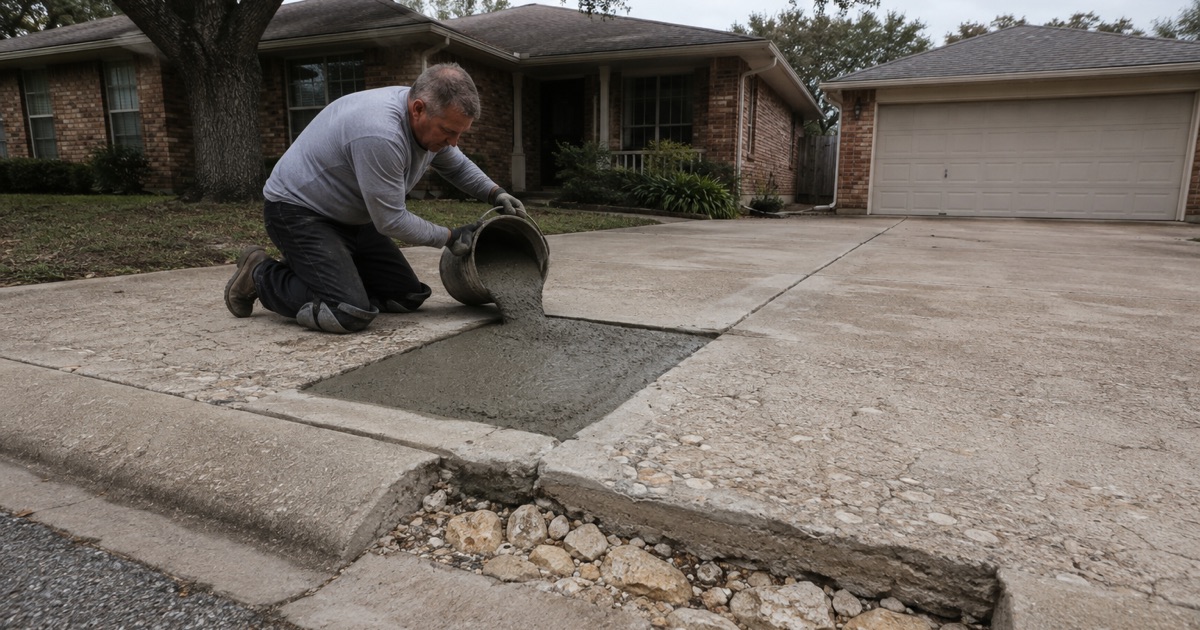
Settlement shows as a slab sitting below its neighbors, often with a tilt toward a downspout, a hose bib or a buried line. The concrete is usually intact; the fill beneath it has consolidated or washed out, leaving a void the slab bridges until it cannot. We probe and sound the slab to map the void before choosing between lifting it, filling under it, or fixing the water that made it.
Shrinkage Cracking, Crazing and Surface Defects
Crazing is a fine surface map with no depth, and scaling, spalling and efflorescence are surface or finishing problems rather than structural ones. They come from a wet mix, from finishing water into the surface, from curing that started late, or from a sealer trapping moisture. These get resurfaced, ground or resealed, and we say so plainly instead of quoting a replacement for a cosmetic complaint.
Structural Cracking and Displacement
A crack that runs full depth, offsets vertically, widens along its length or keeps moving between visits is a different finding altogether. We measure width and offset, check whether the two sides have separated in plane, and look at what the crack lines up with. Where the movement is foundation movement rather than flatwork movement, we say that too, because sealing it would hide the only symptom you have.
Residential Concrete Repair
Driveway and Approach Repair
Driveways fail at their ends: at the garage door where the slab meets the house, and at the street where the approach meets the curb. We repair those two zones as separate problems, because one is an isolation joint and a void and the other sits in the public right of way and is reviewed against city geometry. Repairing the middle while ignoring the ends is why driveways get done twice.
Patio, Walkway and Porch Repair
Patios and walks are where trip hazards, settled panels and failed sealer show up first, and they are also where full replacement is most often oversold. A single settled panel is a panel job. We replace what has failed, match the finish and the joint layout to what is already there, and keep the repair from reading as a patch across the middle of your yard.
Garage Slab and Interior Floor Repair
Interior slabs bring problems the outside does not: moisture through the slab, coatings that have delaminated, and cracks that telegraph through flooring. We check for a vapor retarder under the slab and for active moisture before repairing, because a repair or coating applied over a wet slab lifts again. Where there is no capillary break, we say what that limits rather than promising a finish that will not hold.
Commercial Concrete Repair
Parking Lot Panel Repair
A concrete lot rarely fails uniformly, so we survey it panel by panel and sort the panels into repair, replace and leave alone. That produces a phased scope you can budget across seasons instead of one number for repaving everything. It also lets us sequence the work so your parking count and your fire lane stay usable while the pour cures.
Sidewalk, Curb Ramp and Accessible Route Repair
Repairs on a pedestrian route have to land back in compliance, not just back in one piece. PROWAG holds curb ramp running slope to 1:12, about 8.3 percent, and cross slope to 1:48, about 2.1 percent, and a detectable warning surface has specified dome size, spacing and contrast. We measure the existing route first, because a repair that restores a non-compliant grade has bought you nothing.
Dumpster Pads, Aprons and Loading Areas
Container pads, approach aprons and loading zones fail from point loads and repeated impact rather than from age. Repairing them at the original thickness simply resets the clock. We rebuild these to the loading that broke them, with thickness and reinforcing sized for the truck rather than for the surrounding lot, and we phase the work so waste collection and deliveries keep running.
The Repair Methods We Use
Partial Depth and Full Depth Repair
Partial depth repair removes deteriorated concrete down to sound material and rebuilds the surface, and it works where the damage is confined to the top of the slab. Full depth repair takes the panel through its thickness to the subgrade, which is what a working crack or a failed joint actually needs. We saw cut clean boundaries on both, because a feathered edge fails at its own perimeter.
Crack Chasing and Epoxy Injection
Crack chasing widens a dormant crack into a clean channel, fills it and matches the surface, and it is a durable answer for a crack that has stopped moving. Epoxy injection bonds the two faces structurally and is for cracks that need to carry load again. Choosing between them depends entirely on whether the crack is still moving, which is why we look before quoting.
Grinding, Beveling and Trip Hazard Removal
Vertical displacement gets measured rather than estimated: up to a quarter inch is permitted, a quarter to a half inch is acceptable where it is beveled at one to two, and anything over a half inch has to be ramped. Where a grind clears the number, grinding is faster, cheaper and less disruptive than replacement, and we propose it rather than the panel.
Our Step-by-Step Concrete Repair Process
Site Visit and Measurement
We walk the whole surface rather than the spot you called about, measure crack widths and vertical offsets, and note grades, drainage and where water leaves the roof. The photographs and measurements go in the file so the second visit starts from data.
Cause Diagnosis
We identify the mechanism before proposing a method: consolidation, erosion, shrink-swell, root pressure, load or a finishing defect. Where the cause is water we name the source, because a repair without that step is a scheduled repeat.
Written Scope and Options
You get the repair scope, the method, the materials and the alternatives in writing, including the option of doing nothing where that is defensible. Where replacement is genuinely cheaper over the life of the slab we show that comparison rather than burying it.
Repair and Cure
We saw cut clean boundaries, prepare and dampen the substrate as the material requires, place, finish to match the surrounding texture, and cut or reinstate joints. Cure times are stated up front so you know when the surface takes foot traffic and when it takes a vehicle.
Handover and Maintenance
We walk the finished work with you, hand over the joint sealant and reseal intervals, and note anything we saw that is not ours to fix. Drainage advice is part of that, because the most common repeat repair we see is a good slab under a bad downspout.
- 20+ Years in Business
- Insured
- Free Written Estimates