San Marcos Elite Concrete installs stamped concrete in San Marcos, TX and across surrounding cities including Redwood, Kyle, Geronimo, Buda and Lockhart, with more than twenty years of placing and finishing decorative work here. Stamped concrete is the one service where the crew’s timing on the day matters more than anything written on the quote.
The reason is simple. A stamp has to go into the slab in the window where the concrete is firm enough to hold an impression and soft enough to take one, and that window closes fast in a Central Texas summer. Everything else, the pattern, the color, the sealer, is a decision made in advance. The stamp itself is a decision made in about forty minutes with a crew already standing on the slab.
So we plan around that window rather than hoping for it. That means crew size matched to the pour area, an early start when the forecast calls for it, retarder where it is warranted, and mats laid out and sequenced before the truck arrives. It is unglamorous preparation, and it is the whole difference between a crisp pattern and a shallow, smeared one.
What Stamped Concrete Actually Is
Mats, Patterns and What the Names Describe
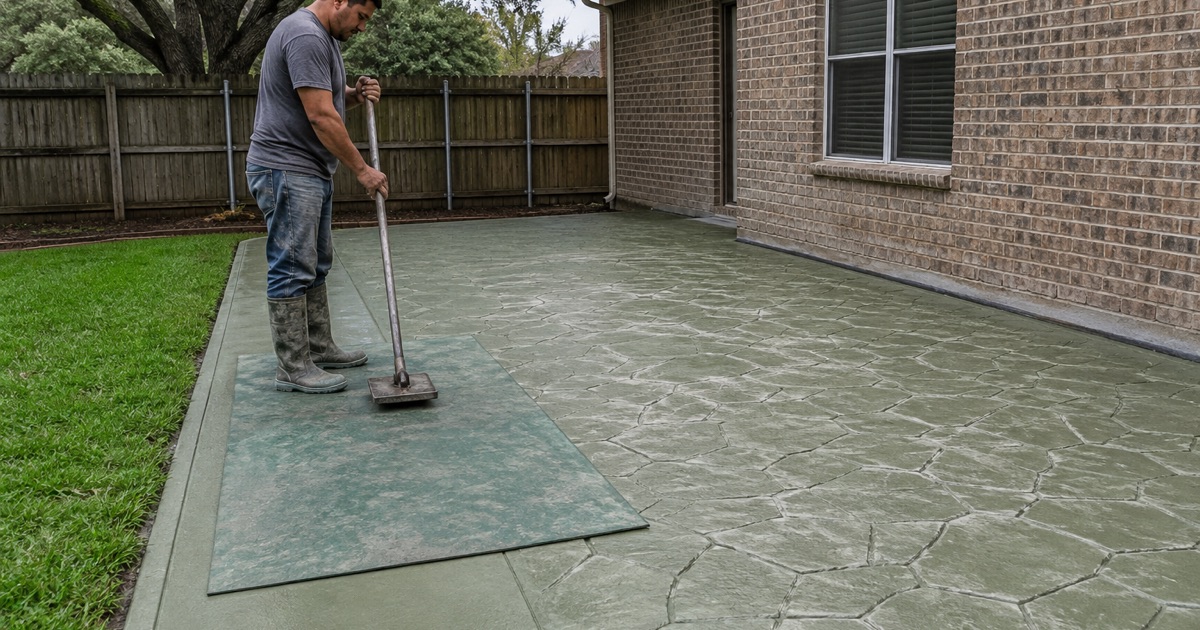
Stamped concrete is fresh concrete pressed with textured mats to imitate stone, slate, brick, cobble or timber plank. The pattern name describes the mat, not a material you are buying, which is why two contractors quoting the same name can deliver visibly different work. We show you the actual mats we own and a sample poured outdoors, because a catalog photograph shot in another state tells you nothing about how it reads here.
Color: Integral, Color Hardener and Release Agent
Color arrives three ways and they do different jobs. Integral color is mixed through the load and goes all the way through, so wear never exposes gray, while a color hardener is broadcast onto the surface for a denser, more saturated top layer. Release agent stops the mat sticking and leaves the secondary, antiqued tone in the low spots. Most good work uses at least two of the three together.
Texture Skins, Borders and Transitions
Not every part of a slab should be stamped. Texture skins give a stone feel without a repeating joint pattern, borders frame a field cleanly, and a soldier course around the edge hides the place where a mat pattern would otherwise run off the form. We plan those transitions on paper first, because the edges are where a stamped slab either looks designed or looks like it ran out of mat.
Where Stamped Concrete Works Best
Patios and Outdoor Living Areas
Patios are the natural home for stamping: they take foot traffic rather than tires, they are viewed close up where pattern detail pays off, and they are usually the right size for a single continuous pour. We plan the pattern layout against the house, the door thresholds and the furniture zones rather than centering it on the slab and hoping the two agree.
Walkways, Entries and Courtyards
Entries and courtyards reward stamping because they are seen at walking pace from a few feet away. Scale matters here more than anywhere else: a large flagstone pattern that looks right on a wide patio reads as one and a half stones across a four foot walk. We size the pattern to the width of the path rather than reusing whatever was on the patio.
Pool Decks, and the Heat and Grip Problem
A pool deck has two requirements a patio does not: it has to stay walkable barefoot in July and hold grip when wet. That pushes us toward lighter colors, textures with real surface relief, and an antiskid additive in the sealer. We keep dark integral color and slick sealers away from pool surrounds, because those are the two choices that make a beautiful deck unusable in August.
Driveways, and the Wear Question
Stamping a whole driveway is possible and rarely the best value, because tires wear the pattern in the traffic lanes while the edges stay pristine, and the result ages unevenly. A stamped border with a broom finished field puts the decorative work where wear does not reach it. We will quote the full stamp if you want it, with an honest description of how it looks in year eight.
Getting It Right on the Day
Timing the Stamp
The stamp window is set by the concrete, not the clock, and in hot weather it can be short. We test the surface rather than guessing, start at the point that lets the crew finish inside the window, and use a set retarding admixture where the pour size and temperature warrant one. A pattern stamped too late is shallow and cannot be fixed afterward.
Joints Inside a Pattern
A stamped slab still needs control joints, and dropping them because they interrupt the pattern is how decorative slabs end up with cracks straight across a stone. We lay joints on pattern lines wherever the geometry allows, so the joint reads as a grout line rather than a defect, and we keep the panel sizes inside the same rules any slab follows.
Sealing, Antiskid and the Reseal Clock
Sealer on stamped work is doing double duty: it protects the color and it deepens it. Film forming sealers give that wet look and will blush or peel if applied thick, over damp concrete, or in direct sun. We name the product, add antiskid where the surface gets wet, and put the reseal interval on the quote so the finish is maintained on a schedule rather than when it already looks tired.
Stamped Concrete Against the Alternatives
Against Pavers
Pavers give you individual units that can be lifted and reset, which is genuinely useful over utilities or where settlement is expected. They also need edge restraint, joint sand and periodic maintenance, and weeds find the joints. Stamped concrete gives a continuous, monolithic surface with fewer maintenance points, at a lower installed cost for most residential areas.
Against Natural Stone
Natural stone is the real thing and it looks it up close, but it costs considerably more installed and depends on the setting bed underneath staying put. Stamped concrete imitates the look at a distance you actually view a patio from, on a single structural slab. Where budget allows either, we tell people the honest tradeoff rather than talking them out of stone.
Against a Decorative Overlay
Where you already have sound concrete, a stamped overlay puts a decorative surface over it without demolition. It cannot fix a slab that is moving or badly cracked, and it is thinner, so it depends on the substrate. We check the existing slab for hollow areas, active cracks and moisture before proposing one, and we say when replacement is the better use of the money.
Before You Commit: Check What Your Subdivision Allows
A recorded declaration and an architectural control committee can restrict color, finish and how much of a lot may be paved, and approval sought after the concrete is ordered is the most common reason a decorative job stalls. We ask for the design guidelines before drawings. Added paving also counts toward impervious cover, which over the Edwards Aquifer carries its own thresholds worth checking before the pour.
- 20+ Years in Business
- Insured
- Free Written Estimates