San Marcos Elite Concrete pours concrete slabs and pads in San Marcos, TX and across surrounding cities including Redwood, Kyle, Geronimo, Buda and Lockhart, with more than twenty years of slab work behind the crews. A slab is the one piece of construction that is judged entirely by what nobody can see once it is finished.
That is not a figure of speech. Thickness, subgrade compaction, base, reinforcing position and the vapor retarder all disappear the moment the concrete goes down, and no inspection afterward can recover them. It is also why two quotes for the same pad can differ so much: one of them may be pricing four inches on whatever is there, and the other a compacted base under a properly chaired mat.
We put those hidden items in writing and photograph each of them before the pour. You end up with a record of the subgrade, the base, the vapor retarder and the steel, which is worth having when a slab is still under your building fifteen years from now.
What the Slab Actually Has to Carry
Shop and Garage Floor Slabs
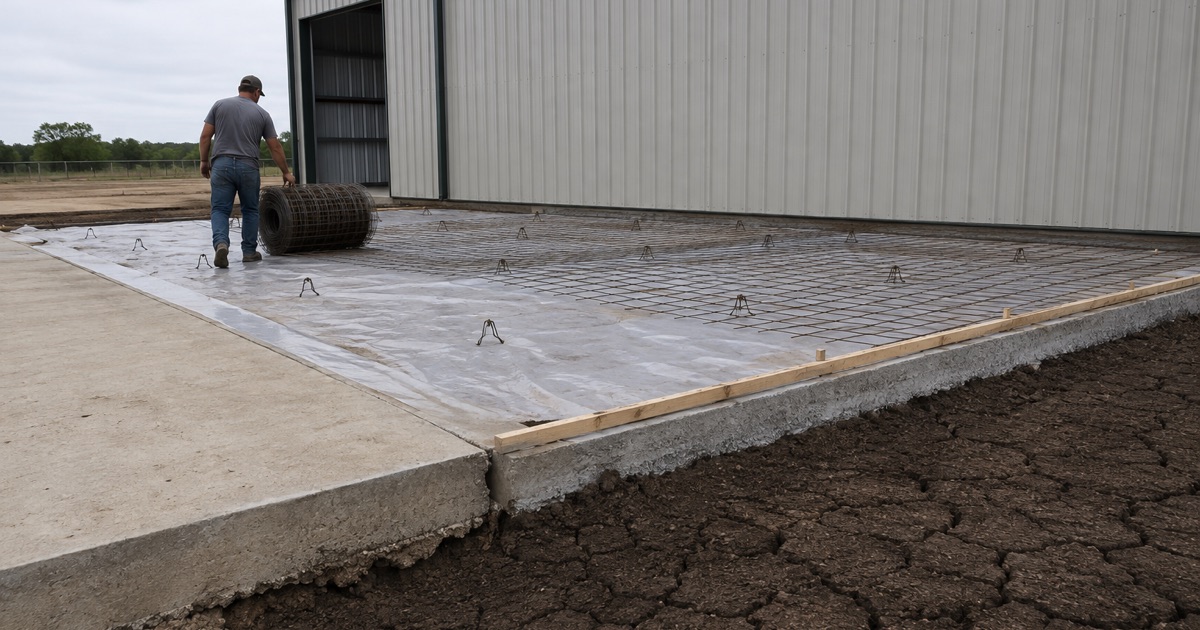
A shop floor carries vehicle loads, point loads from jacks and lifts, and often a lot of abrasion. That pushes thickness up, wants reinforcing at mid-depth rather than dragged to the bottom, and makes joint layout matter because a shop floor is a large uninterrupted area. We ask what equipment is going in before sizing anything, since a two-post lift changes the design under its base plates.
Shed, Workshop and Storage Building Pads
Pads for accessory buildings look simple and fail in predictable ways: too thin at the edges, no turndown where the wall bears, and no allowance for anchoring. We detail a thickened edge under the wall line and set anchor positions with the building supplier’s layout in hand, so the pad matches the structure that arrives on the truck rather than approximately fitting it.
RV, Boat and Trailer Parking Pads
Concentrated wheel loads and long-term static loading are the two things that break parking pads. An RV parks in the same spot for months at a time, and jack stands and tongue jacks put very high point loads through small footprints. We thicken the wheel paths and the jack positions rather than the entire slab, which puts the concrete where the load is and keeps the price sensible.
Generator, HVAC and Equipment Pads
Equipment pads need to be level, stable and often isolated from what is around them so vibration does not travel. Anchor bolt patterns, conduit stub-ups and clearances have to be set before the pour, because coring a finished pad for a missed penetration is both expensive and avoidable. We work from the equipment submittal rather than from a description over the phone.
What Goes Under the Concrete
Subgrade and Measured Compaction
The subgrade is stripped of organics and soft spots, then compacted, and compaction is verified against proctor density rather than assessed by walking on it. On the high plasticity clay in parts of this area, moisture conditioning matters as much as passes with a roller, since clay compacted dry will take up water later and swell under your slab.
Base Course and the Capillary Break
Over the subgrade goes a flexible base course or clean granular fill, compacted in lifts. Beyond providing uniform support, a clean granular layer acts as a capillary break, interrupting the path moisture takes upward into the slab. That single detail is the difference between an interior floor that accepts a coating years later and one that keeps lifting whatever is put on it.
Vapor Retarder Where the Space Will Be Conditioned
Any slab under conditioned space gets a vapor retarder, and specification matters: an ASTM E1745 ten mil sheet, lapped, taped and sealed at penetrations rather than laid loose and punctured by the steel. We place the retarder directly under the slab for interior floors and photograph it before the pour, because it is the item most often skipped and the one most expensive to be without.
Structure, Reinforcing and Engineering
Slab on Grade, Turndown Edges and Footings
Most pads here are slab on grade with a turndown edge, which thickens the perimeter to carry wall loads and stiffen the slab against edge movement. Where loads concentrate we add grade beams, footings or piers instead of thickening everywhere. Choosing between those is a structural decision, and we would rather have it made on paper than compensated for with extra concrete.
Rebar, Fiber and Welded Wire Reinforcement
Number four and number three rebar on chairs at mid-depth is the reliable option for structural slabs, macro synthetic fiber controls plastic shrinkage cracking without replacing structural steel, and welded wire fabric only works when it stays properly chaired off the base. We say which we are proposing and why, and we tie and chair steel rather than pulling mesh up through wet concrete with a hook.
Post Tensioned Slabs and Where They Appear
Post tensioned slabs use tendons stressed after the concrete gains strength and are common on residential foundations over high plasticity clay. They are engineered systems, and cutting or coring one without knowing where the tendons run is genuinely dangerous. Where you have one, we locate tendons before any penetration and coordinate with the engineer rather than working around the drawing.
Codes, Permits and Engineering in This Area
Engineered Foundations Inside the San Marcos City Limits
Residential foundation work here is an engineered item by local amendment. IRC Section R106.1.1.1, added by Sec. 14.041, requires foundations to be designed by a licensed and registered engineer and closed out with a sealed letter of conformance. San Marcos also amends IRC R109.1.1 so a form survey is performed before plumbing piping is placed and approved before the foundation inspection.
Accessory Structures and the Narrow Exception
The engineering requirement carries one narrow exception, for one-story room additions and detached accessory structures of 500 square feet or less built to the city’s own published residential slab design and not tied to a post-tension slab. Whether your pad qualifies is a question worth settling before design rather than at inspection, and we check it against the actual footprint.
Setbacks, Impervious Cover and Deed Restrictions
A pad also has to sit somewhere it is allowed. Setbacks, easements, recorded declarations and impervious cover limits all constrain where and how large it can be, and over the Edwards Aquifer the exemptions in 30 TAC 213 turn on staying under twenty percent of the site. We check these against your plat before pricing, since moving a pad on paper costs nothing.
- 20+ Years in Business
- Insured
- Free Written Estimates