San Marcos Elite Concrete provides concrete leveling in San Marcos, TX and across surrounding cities including Redwood, Kyle, Geronimo, Buda and Lockhart, with more than twenty years spent on the ground that makes slabs move here. Leveling is a support problem, not a concrete problem, and the two get confused constantly.
A slab that has dropped an inch is generally still a perfectly good slab. What has changed is what holds it up. Material has consolidated under load, washed out along a water path, or shrunk away in a dry stretch and left the slab bridging a gap. Once you see it that way, the decision stops being about the concrete and becomes a question of what to put back underneath it.
That is also why leveling can be so much cheaper than replacement. Lifting a sound slab and filling what is under it costs a fraction of tearing out, hauling away, rebuilding base and repouring, and it is done in hours instead of days. Our job is to be straight with you about which of those two situations you actually have.
Why a Slab Sinks Here
Consolidation and Washout Under the Slab
Fill placed under a driveway or apron continues to settle for years, and every wet season accelerates it. Add a downspout discharging at the slab edge, an irrigation leak or a cracked service line, and fines migrate out until the slab is spanning a void. We trace where water enters and leaves before lifting anything, because refilling a void that is still being scoured is temporary by design.
Shrink-Swell Clay and Seasonal Movement
Clay ground here does not settle so much as breathe. Houston Black clay on 1 to 3 percent slopes covers 13.97 percent of San Marcos, and its dominant component carries a representative plasticity index of 44 with linear extensibility of 12.0 percent. A slab on that soil can sit high in March and low in September, so we ask how long the drop has been there and whether it moves before we call it settlement.
Rock, Fill and the Transition Between Them
The worst movement often shows up where conditions change rather than where they are worst. A slab half on undisturbed limestone and half on trench backfill or engineered fill will hinge at the seam no matter how good either side is. We map that boundary, because a lift there needs the fill side supported without jacking the rock side, and treating the slab as uniform cracks it.
Slab Jacking, Slab Stabilization and Void Fill
Slab Jacking Raises a Settled Slab
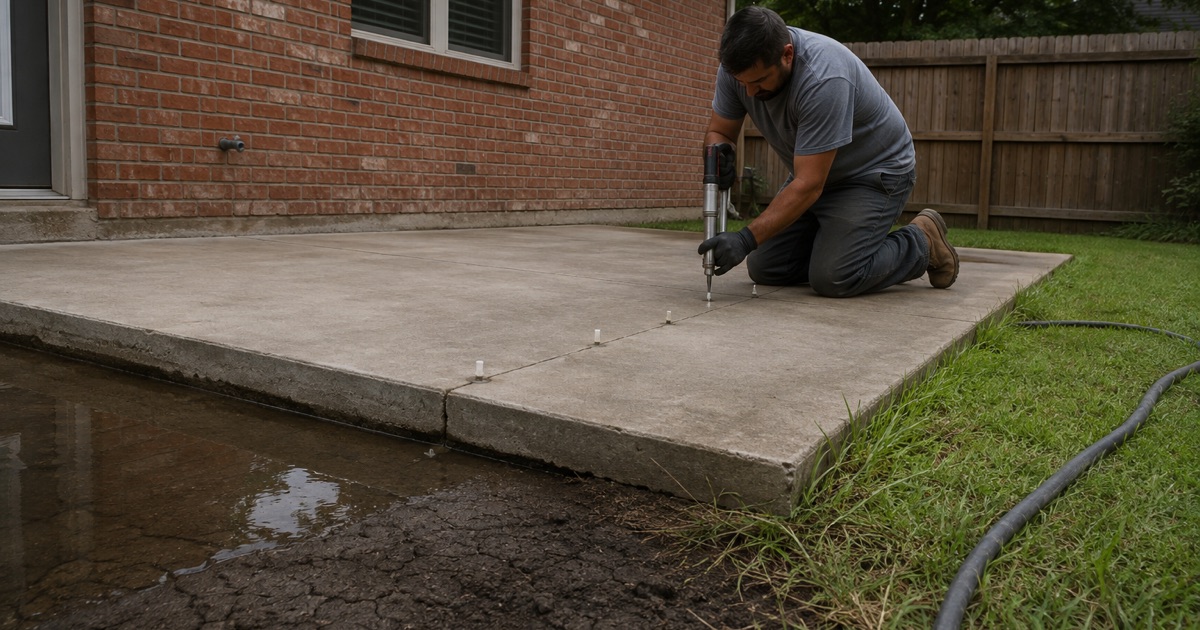
Slab jacking is the operation you want when the concrete has dropped and you want it back at grade. Material is injected through small holes until the slab lifts to match its neighbors and the joints close up. It is measured work rather than brute force: we lift in stages across several ports so the slab rises evenly instead of cracking across the middle.
Slab Stabilization Fills a Void Under a Slab That Has Not Moved
Sometimes a slab is still at grade and sounds hollow. That is a void waiting to become a drop, and filling it is far cheaper than lifting the slab later and repairing what cracked on the way down. We quote stabilization separately from jacking, because bundling the two hides which one you are buying and makes two very different prices look like one.
Void Fill Under Approaches, Aprons and Loading Areas
Commercial approaches, dock aprons and dumpster pads develop voids fast because they take repeated heavy point loads. Filling underneath restores support without closing the entrance for a week, which is usually the deciding factor. We schedule these around delivery windows and trading hours and get the surface back in service the same day wherever the material allows.
Polyurethane Foam Injection Against Traditional Mudjacking
Polyurethane Foam Injection
Foam goes in through holes the diameter of a pencil, expands to fill the void, and reaches working strength in minutes rather than hours. It is light, which matters when the ground under the slab is already struggling to carry what is on it, and it does not wash out. The small holes also mean the patching afterward is close to invisible on a broom finish.
Traditional Mudjacking with Cement Slurry
Cement slurry mudjacking pumps a sand and cement mixture through larger holes and remains the economical way to fill a large void under a thick slab. It is heavier than foam and takes longer to cure, and the patches are more visible. On the right job, particularly a big shop floor or a wide apron over stable ground, it is still the sensible choice.
How We Choose Between Them
We choose on the soil, the size of the void and what the slab has to carry, not on which pump is loaded. Weak or saturated subgrade points to foam; a large void over sound ground where appearance is not critical often points to slurry. Whichever we propose, the quote says which method, why, and what the alternative would have cost.
Where Concrete Leveling Works, and Where It Does Not
Driveways, Garage Aprons and Walks
These are the classic leveling jobs and usually the most satisfying, because the drop at the garage door or the lip at a walkway is both the trip hazard and the eyesore. Lifting closes the joint, restores drainage away from the house, and takes a morning. We check the slope afterward with a level rather than by eye, because a flat slab that drains toward the garage is not a success.
Interior Slabs and Shop Floors
Interior slabs can be lifted, and foam is usually the right material because of the small holes and fast return to service. The complication is what is on top: flooring, racking, equipment or a coating. We plan access and staging around those, and we are honest when the cost of clearing the space exceeds the cost of the lift itself.
When Replacement Is the Honest Answer
Leveling restores support; it cannot restore a slab. Concrete that is cracked into several independent pieces, badly spalled through its depth, or simply too thin for the loads now on it will not come back as one slab no matter how well the void is filled. We say so at the visit rather than lifting it, watching it fail, and quoting the replacement afterward.
Our Step-by-Step Concrete Leveling Process
Survey and Sounding
We shoot elevations across the slab and its neighbors, sound for hollow areas, and mark the void extent. That survey is what tells us how much lift is available before joints or utilities become the limit.
Cause and Water Path
We identify what removed the support, including downspouts, irrigation, service leaks and grading. Where the cause is still active we scope that fix alongside the lift rather than quietly leaving it for later.
Method, Ports and Sequence
We set port locations and a lift sequence so the slab rises evenly and adjacent panels are not disturbed. The plan goes in the quote, along with the material and the expected return to service.
Lift, Fill and Verify
We inject in controlled stages, checking elevation continuously, and stop at grade rather than past it. Ports are patched, joints are cleaned out and resealed where they had opened, and we re-shoot the levels with you present.
Return to Service and Aftercare
Foam-lifted slabs generally take traffic within the hour and slurry needs longer, and we give you the actual figure for the material used. We also note the drainage and joint maintenance that keeps the void from re-forming.
- 20+ Years in Business
- Insured
- Free Written Estimates