San Marcos Elite Concrete builds concrete patios in San Marcos, TX and throughout surrounding cities including Redwood, Kyle, Geronimo, Buda and Lockhart, with more than twenty years spent pouring outdoor living space on this ground. A patio is the one slab people actually sit on, so it gets judged on comfort and proportion as much as on durability.
Most patios that disappoint are not badly built. They are badly sized. A slab drawn to fit the back of the house rather than to fit a table with chairs pushed back ends up as a walkway with furniture on it, and no finish rescues that. We measure the furniture and the walking routes first, then draw the slab around them.
The second thing that decides how a patio ages is where the water goes. A slab that slopes back toward the house puts water against the foundation and holds it in the joint, which is a problem for the slab and a worse one for the structure. We set the grades before forming and check them with instruments rather than by eye.
Designing a Concrete Patio Around How You Use It
Size, Shape and Furniture Zones
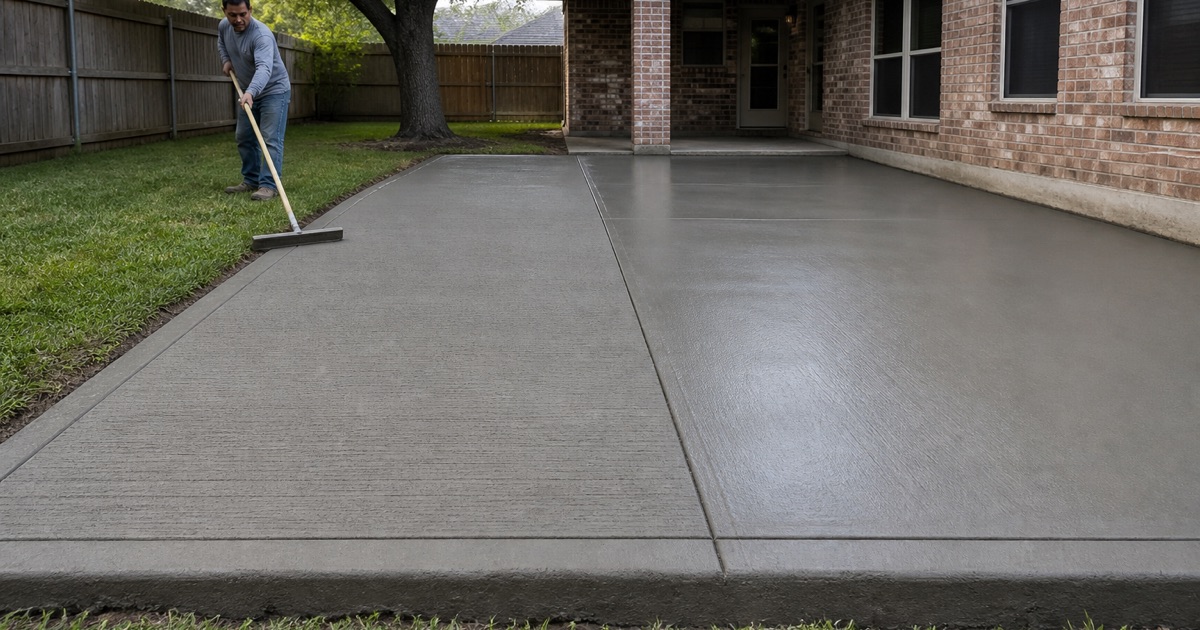
A dining set needs clearance to push chairs back, a lounge grouping needs a walking route around it, and a grill needs standing room that is not a traffic lane. We lay those zones out on the plan and size the slab from them rather than from a round number. It costs nothing at the drawing stage and it is the difference between a patio you use daily and one you use twice a year.
Connecting to the House: Thresholds and Isolation Joints
Where the patio meets the house it gets an isolation joint, not a bond, so the two structures move independently instead of dragging on each other. Threshold height matters too: the finished surface has to sit low enough to keep water out of the door and high enough to stay above the surrounding grade. Getting that wrong is a permanent problem, so we set it before forming.
Slope, Drainage and Keeping Water Off the Foundation
A patio slopes away from the house at a fall you can walk on without noticing but water cannot ignore. Where the yard falls the wrong way, that means a drain, a swale or a small retaining detail rather than a flat slab and hope. We work the drainage into the design rather than treating it as an add-on, because water pooling at the house line is what turns a patio into a foundation problem.
Patio Finishes and Surfaces
Broom, Float and Salt Finishes
A broom finish is the workhorse: grippy, forgiving and easy to repair convincingly later. A float finish is coarser and reads more rustic. A salt finish pits the surface deliberately and gives good traction where water lands. We keep hard trowel finishes off patios entirely, because a dense smooth surface outdoors is slick in the first rain and stays that way.
Stamped Patterns, Borders and Banding
Stamping suits patios better than any other flatwork, since they take foot traffic rather than tires and are viewed close up. A full stamp, a stamped border around a broom finished field, or a sawcut pattern with a contrasting band are three price points for the same idea. We lay any pattern out so it lands on joints the slab needs anyway, rather than fighting them.
Exposed Aggregate and Seeded Finishes
Exposed aggregate washes or retards the surface paste to reveal the coarse aggregate underneath, so what you see is the gradation the ready mix supplier delivered. A seeded finish broadcasts selected stone onto the surface instead, which gives control over color and size that the mix cannot. Either way the stone is chosen before the pour, because there is no changing it afterward.
Color, Stain and Sealer Choices
Integral color runs through the slab and cannot wear off, acid stain reacts with the concrete for variegated permanent tones, and water based stains offer a wider palette closer to the surface. Sealer then decides how much of that you see and how often it needs renewing. We name the product and the reseal interval on the quote, since an unsealed decorative patio looks tired years before it should.
Building a Patio on Central Texas Ground
Expansive Clay Under a Patio Slab
Houston Black clay on 1 to 3 percent slopes covers 13.97 percent of San Marcos, with a representative plasticity index of 44 and linear extensibility of 12.0 percent through the upper 60 inches. A patio on that ground moves seasonally whether or not anyone plans for it. We answer with thickness, reinforcing, moisture conditioning of the subgrade and joints spaced to the slab rather than to the shape of the yard.
Shallow Rock and Sloping Lots
West of the interstate the problem inverts to shallow limestone and slope. Rock close to the surface is excellent bearing and awkward excavation, and a sloping lot means the patio is partly cut and partly fill unless it is stepped. We would rather step a patio into a hillside than build a deep fill under one corner, because fill is the part that settles later.
Reinforcing and Joint Layout on an Irregular Shape
Curves, notches and re-entrant corners are where patios crack, because a corner concentrates stress and the crack starts there. We add reinforcing at those corners, place joints running from them, and keep panels inside a one and a half to one aspect ratio so no panel is long and narrow. That layout is drawn before the pour rather than decided with a saw in hand.
Extending, Covering and Adding to a Patio
Extending an Existing Patio
Adding to a patio is usually better value than replacing it, and the join is the whole job. New concrete gets an isolation joint against the old slab rather than a bond, so the two move independently. Color will not match at first and closes over a couple of years, and where matching matters we can resurface both with a single overlay instead.
Footings for Covers, Pergolas and Outdoor Kitchens
Anything with posts or a roof needs footings sized for it, and those go in before or with the slab rather than being drilled in later. An outdoor kitchen also brings gas, water, drainage and electrical stub-ups that must be set before the pour. We ask about future covers even when they are not in this year’s budget, because a sleeve cast in now costs almost nothing.
Fire Pits, Grills and Hot Tub Pads
A hot tub is a serious concentrated load, filled and occupied, and it wants a thicker, reinforced area rather than a standard patio slab underneath. Fire features need clearance and a non-combustible surround. We build these into the slab design instead of treating them as furniture, since retrofitting support under a filled spa is not a job anyone wants to price.
What to Check Before You Pour
A patio adds impervious cover, and over the Edwards Aquifer the exemptions in 30 TAC 213 turn on staying under twenty percent of the site. Recorded declarations and architectural control committees can also restrict finish, color and how much of a lot is paved. We check both against your plat and your guidelines before ordering anything, because these are cheap questions to ask early and expensive ones to answer late.
- 20+ Years in Business
- Insured
- Free Written Estimates