San Marcos Elite Concrete builds concrete driveways in San Marcos, TX and throughout surrounding cities including Redwood, Kyle, Geronimo, Buda and Lockhart, drawing on more than twenty years of placement along this corridor. A driveway is the largest single slab most households will ever buy, and it is judged on how it looks in year ten rather than the week it was poured.
Three decisions set that outcome, and none of them is the finish. What the slab sits on, how it is reinforced, and where the joints are cut determine whether you get a clean surface with planned cracks or a random pattern across the front of the house. We put all three in writing on the quote so you can compare bids on something other than a square foot rate.
The fourth decision is not ours at all. The part of your driveway inside the right of way is a public work, reviewed against city standards rather than your preference, and it changes shape across our service area. We identify which jurisdiction reviews your approach before drawing anything, because that answer changes the width, the radius and sometimes the reinforcing.
Designing a Concrete Driveway for the Ground It Sits On
Slab Thickness and the Loads You Actually Park
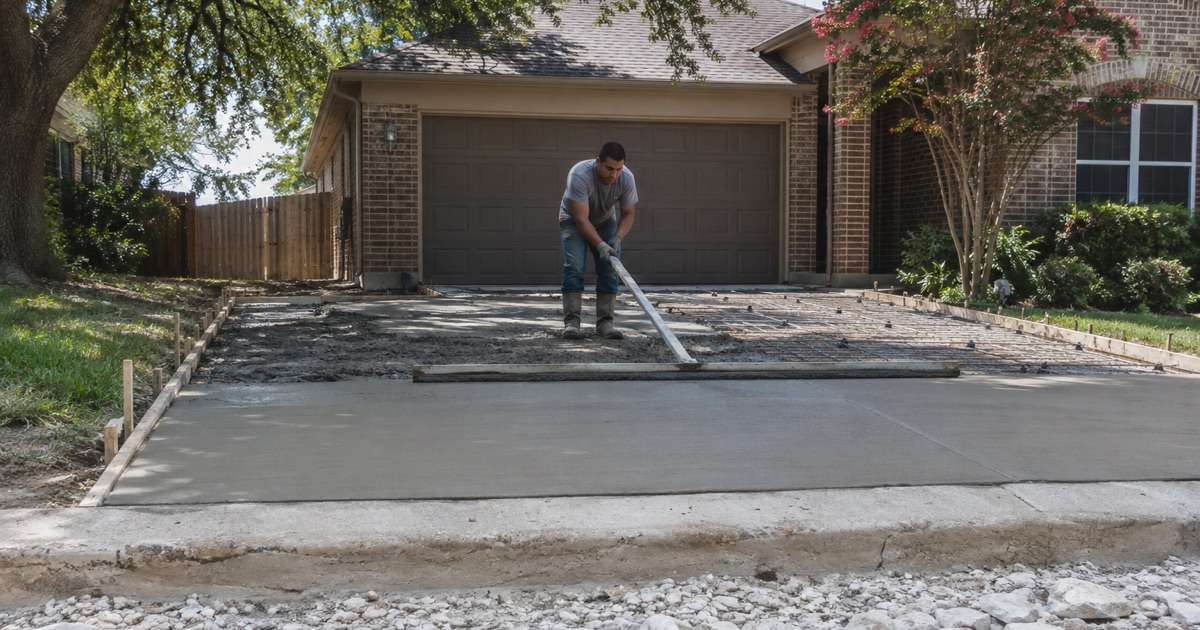
Passenger cars, a dual-wheel pickup, an RV and a delivery truck are four different load cases, and one thickness does not serve all of them. We ask what parks on it, what turns on it and what delivers to it, then size thickness and edge detailing to that. Thickening the edges and the wheel paths costs far less than thickening the whole slab, and it is where the failures actually happen.
Reinforcing, and What Your City Requires
Reinforcement holds a crack tight rather than preventing it, and the choice is partly yours and partly the jurisdiction’s, because the rules in this service area reverse across a city line. Cibolo’s ordinance requires a minimum six inch by six inch, number six gauge welded wire fabric in sidewalks and driveways, Lockhart’s prohibits welded wire fabric in slab foundations and driveways outright, and we build to the code where your lot actually sits rather than to a regional habit.
Joint Layout on a Long Driveway
A driveway is a long, narrow slab, which is the shape most likely to crack badly if the joints are wrong. We cut to the published schedule at twenty four to thirty six times the slab thickness, cap panels at fifteen feet, and keep each panel inside a one and a half to one aspect ratio. Sawcut joints are timed, not left to convenience, because a joint cut late has already been beaten by the crack.
Base, Subgrade and Drainage Under the Slab
Under the concrete goes compacted subgrade and a flexible base course, and compaction is measured against proctor density rather than judged by how it feels underfoot. We also set the slope before forming: a driveway that sheds water to the street or a drain ages very differently from one that ponds against the garage. That grade is checked with instruments before the pour, not adjusted afterward.
The Approach, the Right of Way and City Review
Where Your Driveway Stops Being Yours
Past the property line the driveway becomes an approach, and its width, radius, spacing and angle are set by ordinance rather than by what fits your gates. We build the private portion to your use and the approach to the standard, and we tell you at quote time where that line falls on your frontage so the design does not have to change later.
San Marcos Approach Geometry
San Marcos Code Table I in Sec. 74.193 sets single-family two-way driveways at 10 to 20 feet wide with a 5.0-foot radius and 10-foot minimum spacing between drives, with wider dimensions and larger radii for duplexes, apartments and commercial uses. One-way drives take the same standards except that width runs 12 to 25 feet. The approach angle to the curbline must be approximately 90 degrees for a two-way drive.
Curb Removal, Saw Cuts and Existing Gutter
Where an approach meets existing curb and gutter in San Marcos, the curb and gutter has to be removed to the nearest existing construction joint or a new one, and the approach is built monolithically with the new curb and gutter section back to the property line. Where the city engineer accepts the existing curb, a one inch minimum depth saw cut along the curb face may be required instead.
Finishes and Options for Concrete Driveways
Broom Finish and Everyday Traction
A broom finish is the default for good reasons: it grips when wet, it hides minor variation, and it wears well under tires. The direction and coarseness of the broom are choices rather than accidents, and we set them to run with the drainage so water leaves rather than tracking along the texture. It is also the cheapest surface to repair convincingly in ten years.
Borders, Banding and Stamped Edges
A full stamp across a driveway is expensive and shows tire wear in the traffic lanes. A stamped or colored border with a broom finished field costs a fraction of it, wears where wear does not show, and frames the house better at the scale a driveway is actually seen from. We lay the pattern out so it falls on joints the slab needs anyway.
Color, Sealer and the Maintenance Clock
Integral color is mixed through the load and cannot wear off, which is why we favor it outdoors over surface color. Sealers are a maintenance item with an interval, not a one-time purchase, and a film forming product applied thick or over damp concrete is what produces the milky patches you see on driveways around town. We name the product and its reseal interval on the quote.
Replacing an Existing Concrete Driveway
Tear Out, Base Rebuild and Disposal
Replacement is mostly demolition and preparation, and the pour is the short part. We break out, haul away, then reassess the subgrade rather than pouring straight onto whatever was under the old slab, because the old base is often exactly why it failed. Where the existing base is sound we say so and credit the work rather than rebuilding it for the sake of the invoice.
Widening, Parking Pads and Turnarounds
Adding width, a parking pad or a turnaround is often better value than replacing what you have, particularly when the existing slab still has years in it. The join between old and new is the detail that matters: it gets an isolation joint rather than a bond, so the two slabs are free to move independently instead of dragging each other apart.
Impervious Cover and What Extra Paving Triggers
More driveway means more impervious cover, and over the Edwards Aquifer the exemptions in 30 TAC 213 turn on staying under twenty percent of the site. A widened drive can be the thing that crosses that line and pulls a lot into permanent controls. We calculate the added area against your lot before you commit, because that is a far cheaper conversation than the one afterward.
- 20+ Years in Business
- Insured
- Free Written Estimates