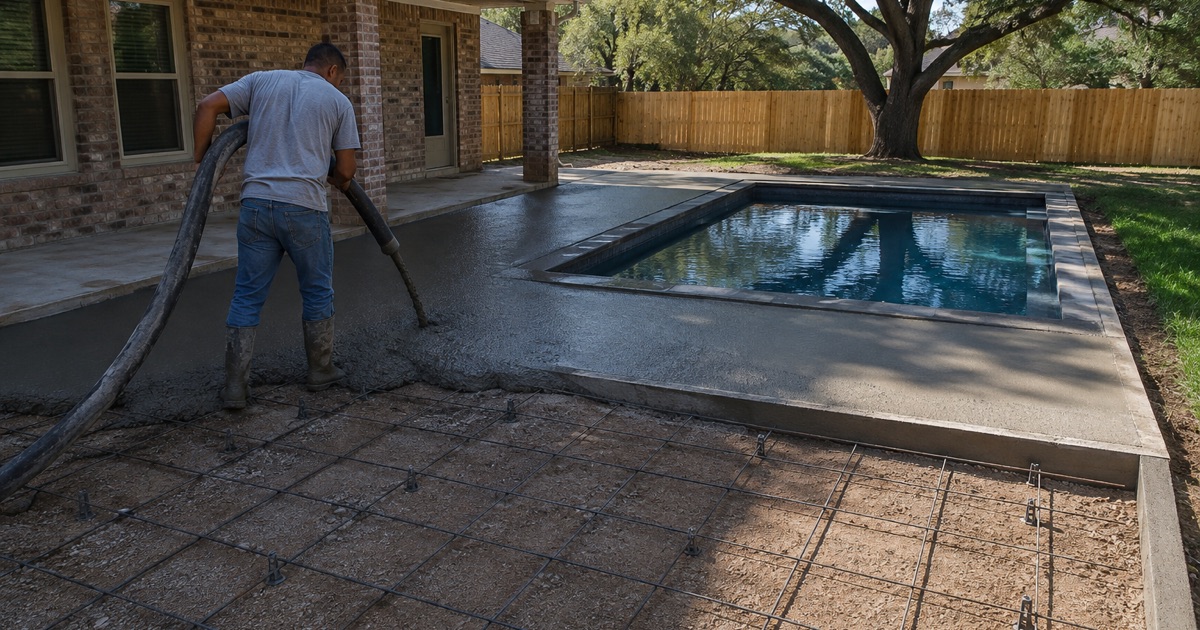
San Marcos Elite Concrete builds and resurfaces concrete pool decks in San Marcos, TX and across surrounding cities including Redwood, Kyle, Geronimo, Buda and Lockhart, with more than twenty years of flatwork on this ground. A pool deck is the only slab we build that gets used barefoot, wet, and in the hottest part of the year, which narrows the sensible choices considerably.
Two requirements bind at once and they pull in opposite directions. The surface has to stay cool enough to cross without shoes in August, which argues for light color and texture. It also has to hold grip when it is wet, which argues for relief in the surface rather than a smooth finish. A deck that fails either test is unusable in the season it was built for.
Everything else follows from those two, and from where the water goes. Deck drainage has to move water away from the pool coping and away from the house, and the deck has to be independent of the pool shell so the two are free to move without dragging on each other. We set those details before forming rather than solving them afterward.
Designing a Pool Deck That Works in August
Color, Heat and Barefoot Comfort
Lighter surfaces absorb less heat, and on a pool deck that is a comfort requirement rather than a style preference. We steer away from dark integral color and dark stains on decks entirely, and where a client wants a darker look we show them the tradeoff honestly. A deck that has to be crossed at a run in July has failed at the one thing it exists for.
Traction When the Surface Is Wet
Grip comes from surface relief and from what is in the sealer. A broom finish, a salt finish or a textured overlay all give real traction, and an antiskid additive in the sealer adds more. Hard trowel finishes and high gloss film forming sealers are the two combinations we keep off pool decks, because both are slick the moment water lands on them.
Drainage, Slope and the Coping Joint
Water has to leave the deck rather than pool on it or run back toward the house, which means deliberate slope, and deck drains where the geometry demands them. At the pool edge the deck meets the coping at an expansion joint that stays flexible and maintained. That joint is the single most common failure point on an older deck, and neglect there lets water under the deck.
Deck Surfaces and Finishes
Broom and Salt Finishes
These are the workhorses, and for good reason: they grip, they cost less than decorative options, and they are easy to repair convincingly later. A salt finish gives a slightly pitted texture that reads more refined than a broom finish while keeping traction. Both take integral color well, so a light, uniform tone is available without going to a stamped system.
Stamped and Textured Overlays
Stamped concrete and textured overlays give a stone or slate look with genuine surface relief, which suits a deck as long as the color stays light. On an existing sound deck, a textured overlay is often the best value available: it changes the appearance, adds traction and lightens the color in one operation without touching the structural slab.
Sealers, Antiskid and Maintenance
Sealer on a pool deck is doing more work than elsewhere, because it faces chlorinated water, sunscreen, sun and constant wetting. We specify a product suited to that exposure, add an antiskid additive as standard rather than as an upgrade, and put the reseal interval on the quote. A deck resealed on schedule looks and behaves far better at year five than one resealed when it already looks tired.
Repairing and Replacing an Existing Deck
Settled and Lifted Deck Sections
Deck sections settle where fill around the pool shell consolidates, and they lift where clay swells or a root gets under them. Both produce trip hazards right where people walk wet and barefoot. Lifting a settled section is usually far cheaper and faster than replacing it, and we quote leveling first where the concrete itself is sound.
Resurfacing a Tired Deck
Where a deck is structurally fine but the surface is worn, stained or too dark, an overlay resets all three at once and takes days rather than weeks. We sound the deck, check for movement and moisture, and confirm the coping joint is sound before proposing one, because an overlay follows whatever the substrate is doing.
Coping, Expansion Joints and Water Under the Deck
An open or failed joint at the coping lets water under the deck, which washes out support and produces exactly the settlement people call about later. Reinstating that joint properly is inexpensive compared with what it prevents. We check it on every deck we look at, even when the call was about something else entirely.
Impervious Cover and What a New Deck Adds
A new or enlarged deck adds impervious cover, and over the Edwards Aquifer the exemptions in 30 TAC 213 turn on staying under twenty percent of the site. Recorded declarations can also limit paved area and finish. We calculate the added area against your lot before the pour, since this is a cheap check early and a serious problem late.
- 20+ Years in Business
- Insured
- Free Written Estimates