San Marcos Elite Concrete carries out concrete resurfacing in San Marcos, TX and across surrounding cities including Redwood, Kyle, Geronimo, Buda and Lockhart, backed by more than twenty years of placing and repairing concrete here. Resurfacing is the option people reach for when a slab looks finished but has not actually failed, and knowing which of those two you have is most of the value.
The honest framing is that resurfacing is a surface solution to a surface problem. Where the concrete underneath is sound, well supported and stable, a bonded overlay gives you a new finish at a fraction of the cost and disruption of replacement. Where the slab is moving, hollow underneath or cracked through, an overlay follows every one of those defects up to the new surface, usually within a season.
So we test before we quote. We sound the slab for hollow areas, check whether cracks are still moving, look for moisture coming through, and assess how well the existing surface will accept a bond. Then we tell you which of the two situations you are in, including when the answer is that resurfacing would only postpone a replacement.
What Resurfacing Can and Cannot Fix
Surface Wear, Scaling and Spalling
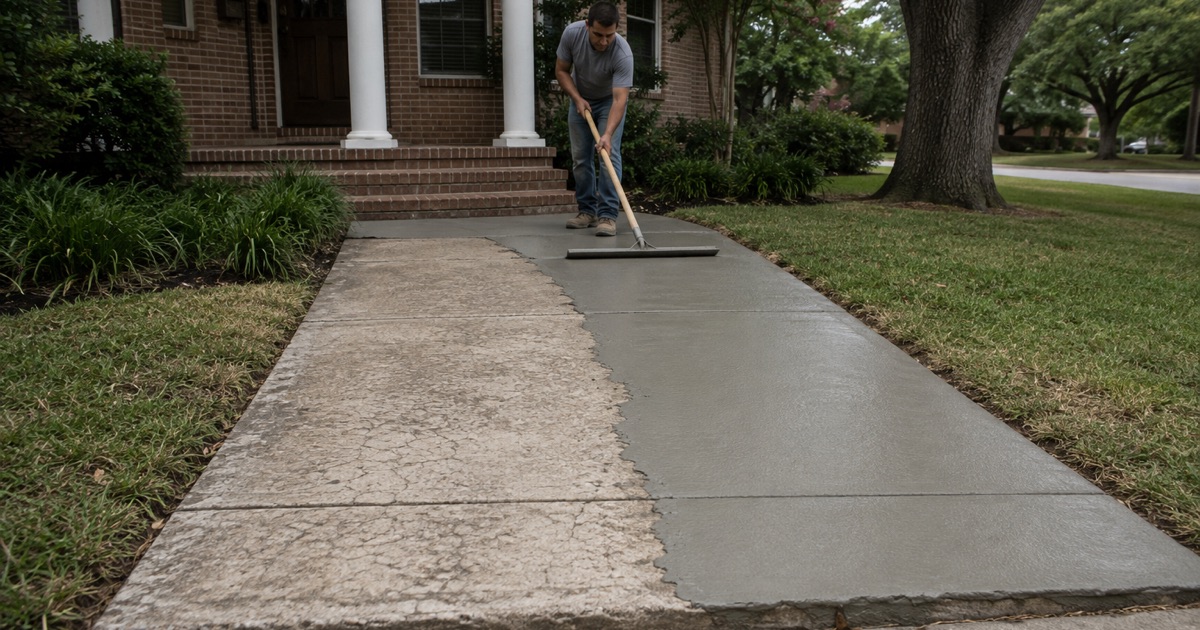
Scaling, spalling and a powdery, worn surface usually come from finishing and curing rather than from a weak slab, so the concrete below is often perfectly sound. Grinding back to solid material and applying an overlay restores the surface and the appearance in one operation. This is the classic case where resurfacing is straightforwardly the right buy.
Dormant Cracks Against Moving Cracks
A crack that has stopped moving can be routed, filled and covered, and it generally stays covered. A crack that is still moving will reflect through any overlay you put over it, because nothing thin bridges ongoing movement. We check for movement rather than assuming, since this single distinction is what separates a resurfacing that lasts from one that fails visibly in months.
Settlement, Voids and Structural Failure
An overlay adds no structural capacity at all. A slab that has settled, lost support or cracked into independent pieces needs the ground fixed or the slab replaced, and resurfacing over it produces a smooth surface with the same problem underneath. Where the slab is sound but has dropped, we quote leveling first and resurfacing afterward, in that order.
The Systems We Use
Concrete Overlays and Microtoppings
A microtopping is a thin cementitious layer, often only a few millimeters, for appearance rather than wear resistance, and it takes color and texture well. A thicker overlay carries traffic and can be stamped or broomed like new concrete. We choose between them on how the surface is used rather than on price alone, since a microtopping in a driveway is a false economy.
Self Leveling Underlayment
Where an interior floor has gone out of plane, a self leveling underlayment finds its own level and produces a flat surface ready for flooring or polishing. It is an interior product and it needs a sound, clean, primed substrate with the moisture situation understood first. Poured over a damp slab with no vapor retarder beneath it, it will fail at the bond line.
Stamped and Decorative Overlays
A stamped overlay puts a decorative surface over sound existing concrete without demolition, which is a strong option for a tired patio or pool deck. The pattern, color and sealing all work as they would on new concrete, but the result depends completely on the substrate. We assess that first and are explicit about the risk where the slab is marginal.
Surface Preparation and Bond
Almost every overlay failure traces back to preparation rather than product. The surface has to be mechanically profiled, clean, free of previous sealers and coatings, and correctly dampened or primed for the system being used. We grind or shot blast rather than acid etching, and we treat the preparation as the main event rather than the step before the interesting part.
Where Resurfacing Fits Best
Patios, Walkways and Entries
These are ideal candidates: light traffic, high visibility, and a surface complaint rather than a structural one. Resurfacing lets you change a plain gray slab to a stamped or colored finish without losing the slab, and it usually takes a couple of days rather than a week. Joint layout from the original slab is carried through rather than covered over.
Pool Decks
Pool decks resurface well and gain from it, because an overlay can add texture and lighten the color, which are the two things that make a deck comfortable in August. We add antiskid to the sealer and keep the color light. The one thing to check first is whether the deck has settled, since a sloping deck around a pool is a leveling job before it is a surfacing one.
Garage and Interior Floors
Interior resurfacing has to start with moisture. A slab with no capillary break or vapor retarder underneath can push moisture up through any overlay or coating, and the failure looks like a product defect when it is a slab condition. We test before quoting and say plainly when a floor is not a good candidate rather than selling a system that will lift.
Commercial Surfaces and Downtime
For commercial floors the deciding factor is usually how long the space can be out of service. Resurfacing is measured in days against weeks for replacement, and it can be phased across sections. We plan the sequence around your trading hours and give the actual return-to-service times for the system we are proposing.
- 20+ Years in Business
- Insured
- Free Written Estimates