San Marcos Elite Concrete grinds and finishes polished concrete in San Marcos, TX and across surrounding cities including Redwood, Kyle, Geronimo, Buda and Lockhart, with more than twenty years of concrete work behind the equipment. Polishing is the one finish that is made entirely from the slab you already have rather than from anything added on top.
That is its appeal and its limitation in the same sentence. There is no coating to peel, no film to blush and nothing to reapply every few years, because the shine comes from progressively finer abrasives and a densifier reacting inside the concrete. What you cannot do is polish a slab into being something it is not. Aggregate, color variation, old patches and previous coatings all show, and the process reveals them rather than covering them.
So the first visit is a survey, not a sales call. We check hardness, flatness, moisture and what has previously been on the floor, then tell you what your slab will realistically look like polished. Where it will not give you the result you have in mind, we say so and price an overlay or a coating instead.
What Polishing Actually Does to a Slab
Grit Levels and What the Number Means
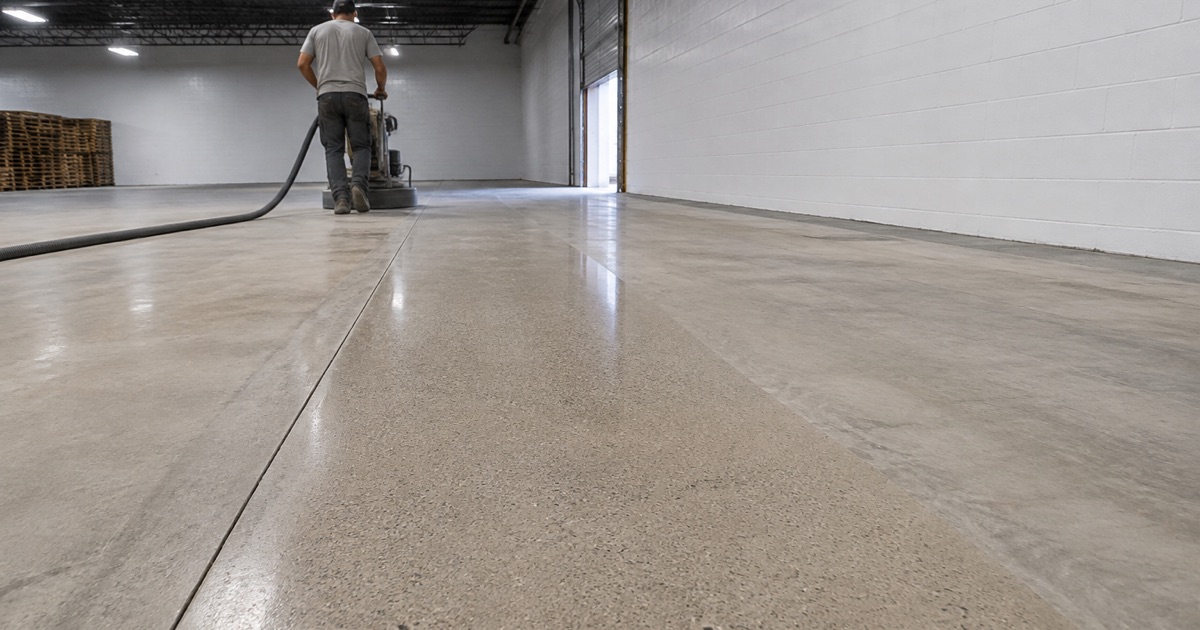
Polished concrete is ground with diamond abrasives in sequence, and the grit number names the last pass rather than the shine. Lower grits leave a matte, low-sheen floor that hides scuffs and needs little attention. Higher grits build genuine reflectivity and show every mark under it. We agree the grit level from samples ground on your own floor, because grinding further is easy and going back is not.
Densifiers, Hardening and Dust Control
A densifier is applied partway through the sequence and reacts chemically inside the concrete to harden the surface and close the pores. That is what makes a polished floor resist abrasion and stop dusting, which is often the real reason a warehouse or shop wants one. It is a chemical reaction, not a coating, so it does not wear off the way a film does.
Exposure: Cream, Salt and Pepper, or Full Aggregate
How much you grind decides what you see. A cream finish stays in the surface paste and keeps the floor uniform, while salt and pepper exposes the fine aggregate for a subtle speckle. Full aggregate exposure cuts deep enough to reveal the coarse stone, which reads dramatically and depends entirely on what your ready mix supplier delivered years ago, so we take test patches before committing to it.
Where Polished Concrete Works
Shops, Garages and Warehouses
This is where polishing earns its keep. A hardened, dust-free floor takes forklift and vehicle traffic, cleans with a machine rather than chemicals, and does not delaminate the way a coating can under hot tire pickup. We usually recommend a lower grit here, since a matte surface hides tire marks and keeps maintenance to sweeping and occasional burnishing.
Interior Living and Retail Space
Indoors, polished concrete gives a hard, low-maintenance floor with no seams and no off-gassing, and it works with underfloor heating. The considerations are acoustics and comfort underfoot rather than durability. We also check for moisture through the slab, because a floor with no vapor retarder under it can drive efflorescence up through a polished surface.
Existing Slabs and What Limits Them
An older slab can polish beautifully or can be a poor candidate, and the deciding factors are hardness, flatness, patches and previous coatings. Soft or badly carbonated surfaces will not take a polish evenly, and old adhesives or coatings have to come off first. We test before quoting rather than discovering it with a grinder running in your building.
Living With a Polished Floor
Sealers, Guards and When Not to Use Them
A polished floor generally does not want a film forming sealer over it, since that reintroduces exactly the peeling and blushing that polishing avoids. A penetrating guard is different and helps with stain resistance in kitchens or workshops. We specify a guard where the use warrants it and leave it off where it would only add a maintenance cycle you do not need.
Cleaning, Burnishing and Long-Term Care
Maintenance is a neutral pH cleaner and a machine, not aggressive chemicals, which strip the surface and dull it unevenly. Periodic burnishing brings back sheen without regrinding. We hand over the actual cleaning regime in writing, because the most common cause of a polished floor looking poor at five years is acidic cleaners rather than traffic.
Repairs, Joints and Patching a Polished Surface
Joints in a polished floor get a semi-rigid filler rather than a soft sealant, so wheels roll across them without breaking down the edges. Cracks and old patches can be filled and ground through, though a filled crack stays visible as a line. We are direct about what will still be seen after polishing, since disappointment here always comes from expecting it to disappear.
- 20+ Years in Business
- Insured
- Free Written Estimates